
Jefferson County Federal Release Routes
The Federal Bureau of Prisons system is a national custody network, not a Jefferson County facility. No BOP institution was identified in the county. A Jefferson County resident convicted federally could have been assigned to any suitable federal institution. A county booking can also end in transfer to federal authority without proving a federal conviction. The legal case, the custodial agency, and the stage of the proceeding all matter.
BOP is the strongest public locator for sentenced federal custody and historical BOP records from 1982 forward. The U.S. Marshals Service often manages custody from arrest or remand through disposition and transport. It can use local, state, federal, or contract space. A person physically held in a county jail for USMS is not necessarily a county criminal detainee. The federal docket and release order are usually stronger for a pretrial release, because BOP may not yet hold a complete record.
| Federal phase | Primary route | Best release evidence |
|---|---|---|
| Sentenced BOP custody | BOP Inmate Locator | Release Date and Location read together |
| Federal pretrial or transport | USMS and federal docket | Court release order plus custodian record |
| Older BOP custody before 1982 | National Archives referral | Archived federal prison record |
| Post-custody supervision | Federal docket and probation records | Judgment and supervision term |
Search Federal Inmate Release Records
Open the BOP Inmate Locator. A BOP register number in the form #####-### is the best key. The locator can also search by DCDC, FBI, or INS number. A name search accepts age, race, and sex filters. Use those fields only to distinguish likely matches, then compare the result with the federal docket and other stable identifiers.
- Search by BOP register number when it is available.
- If the number is unknown, enter the full name and cautiously add filters.
- Open or review the matching result and read Release Date beside Location.
- Compare the register number and identity details with the federal case.
- If the case predates 1982 or BOP has no useful record, follow the correct archive or USMS path.
Results can display the name, register number, age, race, sex, release date, and location. A past release date with “RELEASED” and no institution supports release from BOP custody on that date. A future date is projected and can change, including after sentence recalculation. “UNKNOWN” means BOP has not determined or displayed a term. “IN TRANSIT” may reflect movement, but in some pretrial cases it can remain stale after USMS removes the person and a court later orders release.
The official BOP locator illustrates the national search fields used for federal custody and release history.
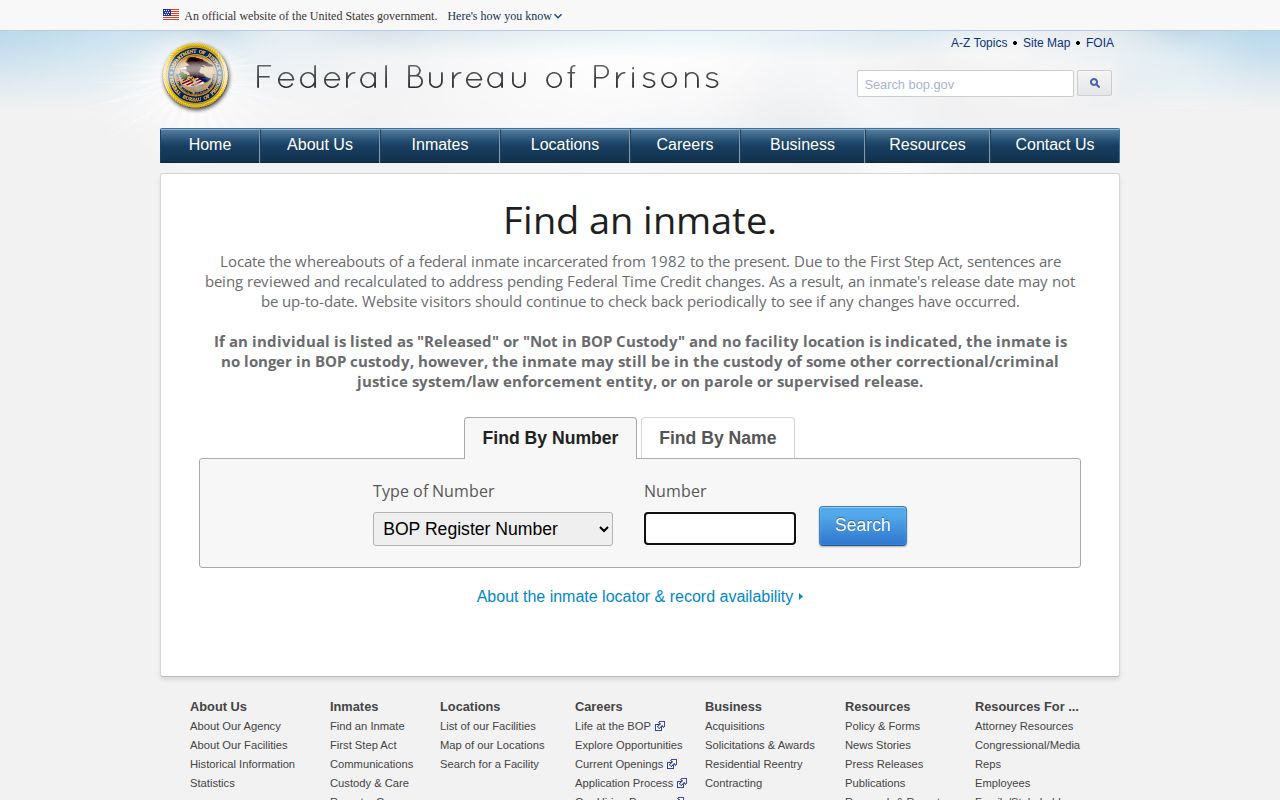
The image shows why a register-number match is stronger than assuming that a same-name federal result belongs to the Jefferson County person.
Interpret Federal Release Status
“Released” in the BOP locator means BOP custody ended. It does not necessarily mean the person has no further legal restraint. A federal judgment can impose supervised release after prison. Another sovereign may have a detainer, which is a request or basis to take custody. Immigration authorities may also become the next custodian. Read the BOP result, federal docket, and any receiving-agency record as one custody chain.
- Release Date
- The past or projected date displayed by BOP, interpreted with Location.
- Location
- The institution, transit label, or released status that gives the date context.
- Supervised release
- A federal court term served in the community after prison, overseen through federal probation.
- Detainer
- A request or legal mechanism that can lead to transfer rather than community release.
BOP records can include pretrial detainees, material witnesses, civil-contempt holds, and cases later dismissed. Appearance in the locator alone does not prove conviction. Likewise, release from BOP does not by itself prove the sentence, charge, or supervision ended. The federal judgment states the legal disposition and any supervised-release term. For a court or legal process, obtain the order from the federal docket rather than infer it from a locator label.
Important: Read Release Date and Location together, then check for a federal court order, supervised release, or transfer to another custodian.
USMS Federal Release Confirmation
The U.S. Marshals Service controls many federal prisoners before sentencing and during transport. Its network may place a detainee in local, state, federal, or contract space. USMS does not provide a public historical release locator equivalent to BOP. That gap matters when a Jefferson County Jail entry shows federal transfer but BOP returns no clear match.
Use the USMS prisoner information to understand the custody stage, then obtain the federal docket and judge's order. For a pretrial release, the court order is often the best legal evidence. The holding institution or USMS record confirms execution. If a public BOP entry still says “IN TRANSIT,” do not override a later court order with that stale label. Seek the custodial record through the relevant federal records process when formal proof is needed.
Federal FOIA, not Pennsylvania's Right-to-Know Law, governs requests to BOP and USMS. Ask for a specific existing custody or release record, identify the person and case, and limit the date range. Privacy and law-enforcement restrictions may reduce what can be disclosed about another person.
Jefferson County Federal Transfers
A name disappearing from Jefferson County Jail may mark federal transfer rather than community release. This is the facility-page form of a locally important custody distinction. First request the county release destination and authority. If the destination identifies USMS or BOP, use the correct federal phase. BOP is most useful for sentenced custody and historical release dates. USMS and the federal court order are stronger for pretrial custody and transport.
The county docket alone may not contain the federal outcome. Match full identity data and the federal case. A federal writ can also produce temporary movement without ending the underlying county hold. Ask whether Jefferson County relinquished custody, temporarily delivered the person, or released the person to another custodian. Those verbs describe different events.
ICE covers civil immigration detention and is not interchangeable with BOP. If the county record names immigration authorities, use ICE ODLS and the ERO route instead. The ICE detention network page explains that distinct path.
Request Federal Release Records
Use the BOP locator as the first public check, but use the originating federal office when a formal record is needed. Ask BOP for an existing custody or release record tied to the register number. For USMS-held pretrial custody, direct the request to USMS and identify the federal case and limited period. For the legal disposition, retrieve the judgment, release order, or docket entry from the federal court.
A useful request separates three questions: when did the agency stop holding the person, under what authority, and to whom was the person released or transferred? Ask for the custody end date, destination, and existing record that reflects the event. Do not ask the agency to calculate a new date or provide a narrative answer. Federal exemptions may protect private or law-enforcement material, but the agency can address the specific record sought.
Federal system routesBOP Inmate Locator: national online search
BOP records: use the official BOP records and FOIA channels
USMS custody: use the official prisoner-information and FOIA channels
Federal legal disposition: federal court docket and filed order
No Jefferson County BOP address or phone is supplied because no federal prison was identified within the county. The actual institution or federal custodian must come from the matched record.
Federal Release Record Limits
The BOP locator updates daily, but a projected date can change. First Step Act calculations and other lawful sentence changes can affect the value. An unknown term is not a release. A no-result is not proof of community release because the person may be in a pre-1982 record, a pretrial stage, another agency's custody, or absent due to identity mismatch.
A county booking date should not be used as a substitute for the start of a federal sentence. Time-credit questions depend on the federal judgment and BOP computation, while a county record only states what Jefferson County held and when its custody ended. If the dates seem inconsistent, gather the county release entry, federal judgment, register number, and BOP status before contacting the records office. That set lets the agency identify the exact custody period without relying on a same-name match or an assumed transfer date.
For older BOP records before 1982, follow BOP's referral to the National Archives. For present custody, record the date checked. For the legal reason, use the federal docket. For physical execution of a recent order, contact the actual custodian or request its record. This evidence chain avoids overstating what a single locator entry can establish.
Use precise status phrases: “released from BOP custody,” “transferred to USMS,” “under federal supervised release,” or “reported released by the holding institution.” Final discharge should be used only when the controlling record supports the end of the applicable sentence and supervision.